Here's a story that is too good not to share. And because those who do read my blog are people of faith, I am not hesitant to do so.
When Don got sick in Mongolia, it was instantly and completely - literally "over night." We had "turned a corner" and found ourselves in the Twilight Zone! Don was in a antiquated hospital in a country half way around the world from our home and I was staying with him every minute I could. There wasn't a cafeteria in the hospital, nor was there any place nearby I could buy anything to eat. Even water was difficult to get. My own health was somewhat put in jeopardy by the circumstances. Senior missionaries brought me food and water which sustained me. Food, of course, was off limits to Don so his pancreas could begin to heal.
The hospital was strange. We were on the top floor. Stepping off the elevator onto the sixth floor was like stepping into an abandoned building. There was a nurses' station but there was not so much as a piece a of paper on the counter and it was kept dark. I actually took the chair at the desk and brought it into Don's room to use as a side table for him. The few times I did leave or go into the hall, I never saw another person in that hallway.
Additionally, sleeping was haphazard, on-and-off day after day for me. The table I slept on had no padding and being hard, made my bones ache. When I did sleep it was from pure exhaustion.
Don was so sick and in such excruciating pain. He kept as sedated as he could keep himself with percocet which we actually got from the mission doctor. There was nothing given for pain by doctors and nurses.
To pass the time, I tried reading a book aloud to Don. We have enjoyed reading books to each other several times in the past. But one chapter was all he could get through. Listening to me read was like nails scratching a chalkboard for Don. He was giving his entire existence to coping with pain. I read the entire book in about three days. This had to be a record for me and is evidence of my wanting to escape from this nightmare I was living.
After taking a percocet, which he did every 3 1/2 hours, he could find about an hour that he could sleep. He certainly did not want to "visit" or listen blissfully to a reading. Other than a toothache, this man had never experienced anything close to this in his life before. I have never felt so helpless as I watched my sweetheart in this condition hour after hour, day after day.
After a day, maybe two, I walked the mile or so back to our apartment for a shower. I did this twice that I can remember. Once, there was no hot water and I had to shower in cold water. I picked up our camera and laptop. A time or two I stopped by the church office building to connect with the Internet so I could communicate with our children who were desperate for some information about their dad.
Don had been given a cell phone by the mission. The senior couples were good to call for updates. But I felt totally alone.
The Lord knew we needed to be reassured that He was aware of us.
Here’s where my intended story begins: We loved the other senior couples we met in the MTC. After eight days in training together, we felt bonded with Elder and Sister Lucas from Utah on their way to Paraguay. We met them first in the MTC. In addition to the Preach My Gospel training, we had special training with the Lucases for the Perpetual Education Fund. Our friendship was instantaneous.
Nearing the end of Don's stay in the hospital in Mongolia we received an email from Sister Lucas who was in Argentina but bound for Paraguay where they’d set up the PEF program there. She had heard about our plight in the Dallas airport! We have never lived in Dallas and don’t know anyone who lives in Dallas. While waiting for her flight back to South America, Sister Lucas was approached by an LDS couple who recognized her missionary name badge. As they visited Sister Lucas discovered that this was my sister-in-law, Carol! This was no chance meeting. The Lord put Sister Lucas and my sister-in-law together in the Dallas airport for me.
She wrote how sorry to she was to hear about our situation and then went on to tell us what had been going on with them. Because she is an RN, the mission president asked her to accompany a very sick elder back to Salt Lake City. She left Elder Lucas in South America and flew back to the States with the sick elder. While in Salt Lake City their son who lived in Salt Lake had a severe heart attack. Sister Lucas just happened to be there to help out with the grandchildren and support her son and daughter-in-law. She returned to her mission after a couple of weeks. It was on her trip back from Salt Lake that she met my sister-in-law in the airport.
She no sooner got back than her husband received a phone call that his father had passed away. So Elder Lucas had to return to the States to help his mother and settle things there. I am glad to report that Elder and Sister Lucas are still in Paraguay setting up the Perpetual Education Fund there among the Latter-day Saints and fulfilling their missionary duties.
When I heard from Sister Lucas about how she’d gotten word about us and about their own set of trials and tragedies, I knew the Lord had moved and managed Sister Lucas and my sister-in-law so precisely to let me know He was aware of Don and me. It brought me great peace and comfort. Knowing that others were enduring trials seemed to validate mine. How miraculous this seemed to me. As time passes, I feel the miracle of this even more. I know that we are personally known by our Heavenly Father. He knows our names and he knows how to succor us - to run to us when we are about to fall, to sustain us in or hour of need. I will treasure this experience for the rest of my life.
Thursday, February 3, 2011

Sunday, January 16, 2011
Service - A Principle of Salvation
First, let me say that I am so surprised at the replies to my last blog and strengthened by the words of confidence and encouragement and thank you sincerely.
Since my last blog more blessings have come from my Heavenly Father. I realized that I needed to get out and serve. Opportunities to serve have come. We were asked to speak in Sacrament Meeting later in January. The invitation was given on the very day I wrote my last blog and was feeling so downhearted. Topic: adversity! It was as though the Lord said to me, "I know you, Kathy, and I think YOU may be able to give some encouragement to some folks in a couple of weeks."
The next week, which was last Monday, January 10th, we went to a Ward Family Home Evening at the bishop's home. I was given a calling to teach Sunday School. I love, LOVE! teaching the gospel!! The day before we attended Gospel Doctrine class and it was "the bomb!!" We had a great teacher (discussion leader) and there were so many contributions and the lesson just came alive for me. I felt the Lord whisper to me again, "I'll help you do something you love doing that will help you as you try to help others."
I signed up to have the Family History couple in the ward come visit us to answer questions and get us started on our genealogical work. They actually came a day earlier than our agreed appointment. I hadn't pulled out our records and wasn't prepared. But they stayed and we opened the computer to a whole new world!! Besides the NewFamilySearch website, the Jasters showed me four other websites which provided names on Don's family line he hadn't found before!! I felt the Lord telling me, "I have things for you to do and here's where you start."
Our Heavenly Father IS in the details of our lives. As for adversity, well, it is our blessing, isn't it! It is through adversity that we get out of comfort zones and search for Divine direction. The best antidote for discouragement, depression and disappointment is service - a principle of salvation. I'm thankful for the capacity to serve.
Sunday, January 2, 2011
First Fast Sunday of 2011
Wow! Life does throw curve balls. This quiet Sunday morning finds me struggling a little. I feel so letdown that things aren't turning out quite how I had envisioned. We do have a lot of blessings and that is what I need to concentrate on today in order to bury disappointment and perplexing events. The holidays are gone and a new year lies ahead. It will be what I make it to be. I am retired and have time to do things which have been put on the back burner. The first on my list is to edit my old missionary journals from 1976 to 1978. Writing was a therapy for me as a young woman in the mission field. Maybe I can discover why missions have to be almost impossibly difficult.
I do believe that God is in the details of our lives. I also believe He respects our agency and won't interfere unless we give Him some sort of entrance - a prayer, a thought, a desire, a hope. I recently read, "The Lord is voting for me, and Lucifer is voting against me, but it is my vote that counts." With a heart heavy with discouragement, I am determined to find a way to be useful doing, hopefully, what the Lord might desire of me. There are so many things - family research, studying, volunteering, serving.
And since no one ever reads this blog, I think I am safe in writing, for therapeutic purposes, what's on my mind and in my heart. But I will try to pretend that someone IS reading and think of something uplifting I might say or express to encourage and uplift another's heavy heart.
Thursday, October 21, 2010
Our Last Days in Mongolia

 The bathroom in Don's hospital room. The Song Do Hospital is privately owned by Koreans. The doctor Don had was Mongolian and very attentive to his case. This was probaby the best in the country, in fact. Don had ultrasounds, CT scans, bloodwork and an x-ray. We are not sure what antibiotics were given to him to treat his diagnosed acute pancreatitis, but we feel it did help enormously. For pain, Don took percocet given him by the mission doctor, Elder Eliason. In fact, it saved him a lot of discomfort.
 It was clean but it wasn't the height of comfort. This was Don's cot for 5 nights in the Ulaanbaatar Song Do Hospital where he was treated for acute pancreatitis. Neither the head nor the feet of this bed could be propped up. He had no bedside table so we used a chair.
There is a little refridgerator in the corner and there was a TV which showed Fox News from about 1AM to 7AM. Believe me, we did little sleeping in this "hotel."


I stayed with Don in the hospital and slept on this hard table-like bed. Being almost 62, it was hard on my bones!!


A playground across the street from the hospital gone to weeds. The Mongolians don't seem to understand that if the keep grass mowed, it grows thicker and looks so much better. Landscaping is not one of their fortes.


Picture taken from 6th floor of Song Do Hospital looking across at the construction of the new government building. Sooty haze in horizon.
 This picture is taken from the 6th floor of the Song Do Hospital window. In the foreground, the only five-star hotel in town can be seen, while in the background can be seen the sooty horizon from the ger districts. We are told that in the winter there is terrible pollution caused by burning coal by people living in the gers.

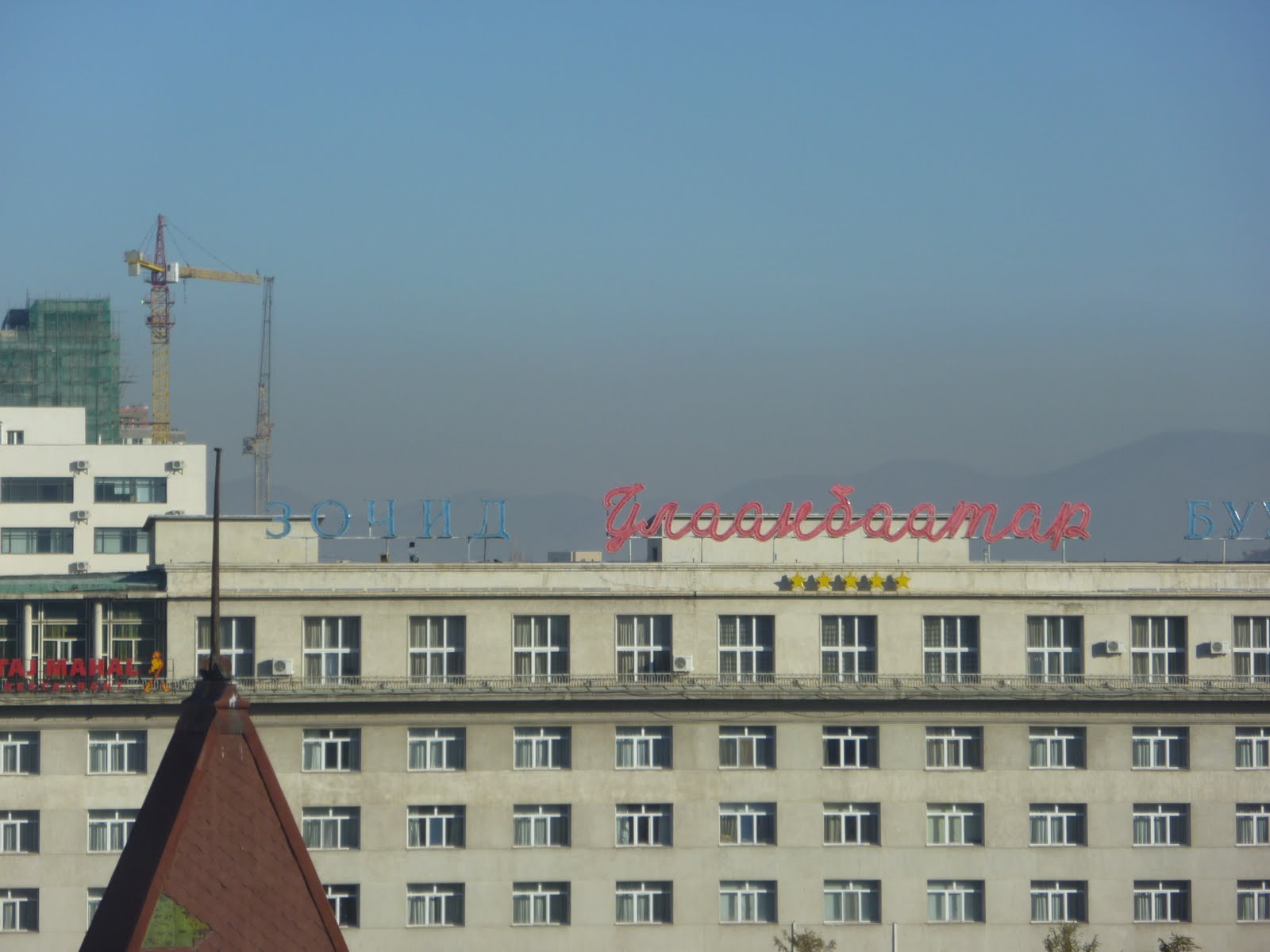 This picture is taken from the 6th floor of the Song Do Hospital window. In the foreground, the only five-star hotel in town can be seen, while in the background can be seen the sooty horizon from the ger districts. We are told that in the winter there is terrible pollution caused by burning coal by people living in the gers.
Memories of Mongolia


Elder and Sister Lasson are playing "anklebones." This is a common game played by Mongolians showing their creativity and use of resources. These little bones are ankle bones from sheep. They clean them up and play games with them. I was actually given an ankle bone set by my dear friend, Megaa as a going away gift. I am looking forward teaching my grandchildren how to play. I think they will like it!!
 These are two girls walking arm in arm along the street. I have no idea who they are but wanted to record this social behavior. There are a couple of reasons for walking arm-in-arm: first, the sidewalks and walkways in dire need of repair and in most cases are dangerous; and secondly, in the winter the sidewalks are icy and slippery and the girls can help each other stay on their feet. All women are very comfortable walking together and there is no a perverted thought in so doing.
 Don is with Battar, a city councilman we were privleged to tutor every day. They are standing in Suhkbaatar Square in the city of Ulaambaatar. Battar is trying to learn English so he can pass an English proficency test in November. Learning English is the desire of almost every Mongolian. Having this skill will enable them to get better jobs and have more opportunities to move forward in the world.
 Here we are with our interpreter, Nasaa at the ARP meeting on Tuesday night - the last night we participated in any of our missionary assignments. At midnight on this night Don got vilolently sick and so our mission came to an end.

 These are two girls walking arm in arm along the street. I have no idea who they are but wanted to record this social behavior. There are a couple of reasons for walking arm-in-arm: first, the sidewalks and walkways in dire need of repair and in most cases are dangerous; and secondly, in the winter the sidewalks are icy and slippery and the girls can help each other stay on their feet. All women are very comfortable walking together and there is no a perverted thought in so doing.
 Don is with Battar, a city councilman we were privleged to tutor every day. They are standing in Suhkbaatar Square in the city of Ulaambaatar. Battar is trying to learn English so he can pass an English proficency test in November. Learning English is the desire of almost every Mongolian. Having this skill will enable them to get better jobs and have more opportunities to move forward in the world.
 Here we are with our interpreter, Nasaa at the ARP meeting on Tuesday night - the last night we participated in any of our missionary assignments. At midnight on this night Don got vilolently sick and so our mission came to an end.
One of the assignments we had was to attend the Addiction Recovery Program class held every Tuesday evening. We had to have an interpreter, shown here on the right, our darling Nasaanjargle. She met an Elder Porter in the Provo MTC. He was on his way to Mongolia and she was on her way to Indiana. Now that they are home from their missions, Elder Porter "came calling" on Nasaa in Mongolia, proposed and they are waiting for the necessary immigration paperwork so she can go to America to marry him. We love Nasaa!! She is such a lovely person with a pure heart. Elder Porter is a very lucky fellow!!
On the left is Sister , the ARP class leader. She is very skilled at listening and giving advice and explaining how the twelve steps can change lives.
 The Spirit of the Lord shines from their eyes. These are sister missionaries from Mongolia to Mongolia. There are about 120 missionaries in the Mongolia Ulaanbaatar Mission. Of those, only seven are from America. There are 900 returned missionaries - the highest rate of returned missionaries to members in the world! They are wonderful people and we were blessed to be with them, if even for a little while.
 Ulaanbaatar city buses. They pack them in! We never got brave enough to try the bus. However, we did stand on the side of the street with our hand out, waited for someone to stop and give us a lift for 1,000 Ts. It was a bargain! There are taxis in town, but any ole person behind the wheel would do as well. Something we would never think of doing in the States!!
 The Spirit of the Lord shines from their eyes. These are sister missionaries from Mongolia to Mongolia. There are about 120 missionaries in the Mongolia Ulaanbaatar Mission. Of those, only seven are from America. There are 900 returned missionaries - the highest rate of returned missionaries to members in the world! They are wonderful people and we were blessed to be with them, if even for a little while.
 Ulaanbaatar city buses. They pack them in! We never got brave enough to try the bus. However, we did stand on the side of the street with our hand out, waited for someone to stop and give us a lift for 1,000 Ts. It was a bargain! There are taxis in town, but any ole person behind the wheel would do as well. Something we would never think of doing in the States!!
Tuesday, October 12, 2010
The Nobel and Great Ones
I want to write about the senior couples Don and I were privileged to know in Mongolia. Every couple has left retirement and children and grandchildren to go work using their skills, abilities and effort at building up the Kingdom of God on earth. Their vision is clear and the faith is steady and strong.
They truly are “…other choice spirits who were reserved to come forth in the fullness of times to take part in laying the foundations of the great latter-day work… I observed that they were also among the noble and great ones who were chosen in the beginning to be rulers in the Church of God. Even before they were born, they, with many others, received their first lessons in the world of spirits and were prepared to came forth in the due time of the Lord to labor in his vineyard for the salvation of the souls of men.” Doctrine and Covenants 138:53-55


Elder and Sister Powell are from the Provo area. Having taught junior high school for 35 years, Elder Powell and his wife are responsible for the English teaching by the American missionaries. Mongolia prohibits the proselyting of religion especially by outsiders. Americans are allowed into the country only as “English teachers.” The Powells have spent endless hours organizing material in the English library in the Bayanzurkh church building. Drawers of work pages and shelves of reference materials organized for easy access by all English teachers. Many of the young returned missionaries want to attend BYU-Hawaii. In order to do that, they must pass the Michigan English test. The Powells have made available not only materials but classes to prepare them to pass the test.
The day we arrived in Mongolia, Elder Powell was asked to step in as the acting mission president in Pres. Mecham’s absence. He had served as the secretary in the mission presidency. Dealing with missionaries in Mongolia has unique challenges. These young people are called, set-apart fulltime missionaries laboring in their hometown – with their non-member moms, dads and girlfriends 10 minutes away. Many of the 120 missionaries were actually called and were serving in other missions in the world, then “recalled” to come back to Mongolia to finish out their missions when the government of Mongolia kicked out all the American elders and sisters who had been serving there. It seems that the Americans hadn’t taken the English teaching seriously and weren’t, in many cases, doing it so they kicked them out! This happened within the past year. Then the unexpected challenge of having Pres. Mecham leave, these young men and women’s commitment was challenged. Our leaving has left the mission shorthanded. Simply stated, it’s been tough on the mission. President Powell has done a remarkable job under these very difficult circumstances.
Sister Powell welcomed us with a housewarming gift of a jar of Jiff peanut butter and a loaf of her homemade bread.. We leaned quickly that this was a sweet and generous gift! While Elder Powell was being “President Powell,” she was keeping things running smoothly in the English department which duties they formerly carried out together. As I pointed out before, a lot rests on English teaching. Every American missionary teaches English, including the doctor! The Mongolian government has made it clear why they think we’re there and it isn’t to share the gospel.
I can’t help but wonder if he and Sister Powell weren’t given “lessons in the world of spirits” to deal with this. They truly are “noble and great.”

Mongolia is Elder and Sister Eliason’s second mission. They first were called and served as the medical doctor in Chile which included 13 missions. Now Elder Eliason is the mission doctor for Mongolia, the only mission in the world with its very own doctor. He took good care of Don when he got so sick. Elder Eliason had become acquainted with a good Mongolian doctor in the Ulaanbaatar SongDo Hospital and knew that was where Don needed to go to be treated. Elder Eliason conferred with and gave suggestions to the doctor so that Don would receive the best care possible. Then as the diagnosis was made that Don had acute pancreatitis, Elder Eliason was in contact with stateside doctors asking for opinions and advice to make sure the best decisions were made in Don’s behalf. We owe a great deal to Elder Eliason, appreciating and admirig his calm, sure demeanor and thorough care.
Elder Eliason keeps the young elders and sisters healthy advising them about exercise, healthy eating and safe drinking water. He has had to deal with emergency surgery and accidents. At one point he accompanied a senior missionary home who’d had a heart attack. He is serving as a doctor and paying for the privilege, supporting himself and his wife on their mission. Talk about selfless!
Sister Eliason’s duties are directing Family History and organizing temple trips. Mongolia really needs its own temple. One of the qualifications for a temple is that the people need to have 50,000 names ready for temple work. The nearest temple for the Mongolian people is Hong Kong, an expensive three-day train trip away. Sister Eliason organizes a temple trip every quarter and has something to do with temple preparation classes.
In addition to all this, she and Elder Eliason teach English in the special medical schools, their primary role according to their visas. They carry out assignments in their branch when Elder Eliason does home teaching every Sunday evening at 7:30 and Sister Eliason plays the organ for sacrament meetings and has several other branch assignments. It is amazing what people will do when they believe there is a prophet of God on earth!! They go anywhere and do all they can to build up Zion!

Elder and Sister Clark are from Tallahassee, Florida. They served their first mission to Mongolia, went home for six months and decided to return to Mongolia again. They run the Perpetual Education Fund and Returned Missionary Office in the Ulaanbaatar. They love the young people and the young people love them! The Clarks love Mongolia and find joy every day in their missionary work. They are a joy to be around! Elder Clark has a hard time saying the unusual Mongolian names so he gives them nicknames. They don’t seem to mind at all but, coming from Elder Clark, consider their nickname a term of endearment.
The Clarks have covered the walls of the returned missionary office with pictures of all who have completed their missions by year. They know their names and when and where they served and what they are up to now that they are home.
Sister Clark is the social leader for the senior missionaries, organizing potluck dinners and other get-togethers. Senior missionaries enjoy one another and will be lifelong friends. Besides that, she helped organize a service project making baby quilts, knit caps and ties for new mothers. Twenty-five or 30 warm, new tied quilts made with adorable baby fabric in soft colors with a knit cap and ties to keep the quilts around the babies in winter were made in a joint effort by the youth and young single adults. Because they had no quilt frames, the young men kept the quilts taut by holding the corners while the young women tied them. The Young Single Adult women sewed the edges and made the ties. A quilt with a baby’s knit cap and a tie were put in individual bags and taken to a maternity hospital. One of the new fathers had his baby wrapped in a towel the day the quilts were delivered. Can you imagine the joy of wrapping his new baby in one of those beautiful baby quilts?!
There are a couple of stories Sister Clark told me about Elder Clark which I enjoyed hearing. The first is about a young Mongolian boy who was going to school at one of the medical schools in Ulaanbaatar. He joined the Church and developed a desire to go on a mission. But he had to get a release from his school in order to go. Elder and Sister Clark went to the school to speak with the school officials about releasing the young man so he could serve a fulltime mission for the Church. Elder Clark explained how that the young man would return more prepared to study, he would learn people skills which would benefit him in the medical profession and that he would most likely learn the English language – all excellent reasons to let the boy go on a mission. Then the school official asked the Clarks if “their organization” was the one which provided the wheel chairs. Elder Clark responded that it was. The school official said his school could use some wheel chairs. Elder Clark asked how many could they use? About a hundred was the reply. Elder Clark assured him he’d ask about it. Apparently, the wheel chairs were provided and the boy has been on a mission in the Washington D.C area for about a year. Elder Clark refers to the young missionary as “Elder Cha-Ching” because it was a big price to ay to get him on a mission.
The second story I enjoyed about Elder Clark was concerning a lady’s coat. Upstairs in the furthest corner of the 5th floor is a storage room. Besides some food storage, in this room one can find everything to outfit a missionary including garments, shirts, ties and coats. These items have been left behind for the use of anyone who may need them. It seems that Sister Clark, while on her first mission, saw a coat she needed to get her through the harsh Mongolian winter. It was full-length with a hood which had fur around the edge. Indeed it was a coat made to shield someone from the severe cold Mongolian winters and Sister Clark took it. Elder Clark named the coat “Fifi.” She wore the coat throughout her mission. As she was preparing to leave her mission, Sister Clark gave the coat back. After all, they were heading back to balmy Florida and had no use for an extreme weather coat there. Once they decided to return to Mongolia, Sister Clark had to buy new winter clothing again since she had left most of her clothes in Mongolia for sisters to use. But she had trouble finding a new coat to buy. Once back in Mongolia, she looked for “Fifi.” Come to find out, “Fifi” had been borrowed by Sister Anderson who is serving north near the Siberian boarder of Mongolia and is making good use of the coat.
While I was there, Sister Clark did find another very warm coat which she borrowed. I wonder if Elder Clark will name it?

Elder and Sister Lasson have the responsibility to lend humanitarian aid to the people of Mongolia. Elder Lasson is a retired civil engineer in a country where those skills have been of great value to the people. Besides making it possible for hundreds of wheel chairs to come into the country, he and Sister Lasson have labored to make possible the building of “dump tanks” which supply clean drinking water to several ger districts in Mongolia. They have organized neonatal training to prevent infant mortality in the country. Theirs is a remarkable, gospel-in-action service which has lifted the very well-being of Mongolians whose life expectancy is sixty. I encourage you to read about their experiences in their own words by reading their blog at www.makingmemoriesinmongolia.blogspot.com
Elder Lasson is a counselor in the mission presidency. Sister Lasson works in Primary in their assigned branch. Of all the adventures they have, out of necessity, driving in Mongolia is something Elder Lasson does well – and that’s saying something! Mongolians have to be the world’s best drivers and the scariest!! Elder Lasson goes with the flow and truly falls into the “best driver” category. When we first got to Mongolia, Elder Lasson took us on a tour of the town. We felt his love of Mongolia and his excitement for the work going on there. In the short time they have spent on their mission, the Lassons have accomplished great things to lift and improve the lives of the Mongolian people. They are “doers of the word” who have put into action their faith in the Lord and His plan. What a joy it has been to rub shoulders with these magnificent people!

Elder and Sister Ford came to Mongolia a couple of weeks after us. Their assignment is to run the mission office. Sister Ford told me she never wanted to be a secretary. Wow, the Lord knows how to challenge us! The mission has been without an office couple for several months. The Fords have been a great blessing. Their main concern in the very short time they have been in Mongolia has been to get a grip on the office and make it function smoothly. Like the other couples, they put in long hours every day getting it done. As time goes by they will get involved with a branch and have callings which will strengthen the Church. They have already begun teaching an English class on Thursday nights at the chapel. Their latest class was attended by nearly 60 people!
Elder Ford established and ran a greenhouse in Colorado where they produced millions of pounds of tomatoes and shipped them all over the country. I wonder how this will play into his mission in frigid Mongolia!! No doubt about it, Mongolia could use tomatoes – and celery and lettuce and other vegetables.
There are two other couples, both Andersons, who live some distance from the city. They work in outlying area where they give support to the Church and teach English classes. We never met these couples but heard about their roles giving stability and strength to the Church and communities.
We saw with our eyes and heard with our ears and felt with our hearts these great missionaries called to serve in Mongolia. What an honor to have been among them and to be considered a part of them though it was such a short time. These are noble and great people doing noble and great work among the Mongolians.
Steven Covey wrote of missionaries, “In the mission field you experienced a quality of spiritual and service life, likely unknown to you before. Many of you felt after leaving home that you had left the Garden of Eden and gone out into the ‘lone and dreary world.’ But gradually, as the months passed and through the divine process of missionary work, study and prayer, your heart and your world changed from a physical, social, self-centered one to a spiritual one where all of your energies and enthusiasms and time became focused on one grand goal – that of bringing souls to the Lord and His Restored Church and Gospel.
“This is why to a great degree you felt far more wrenched on leaving the mission field than you did on initially leaving home. Your heart had changed and so had your world, and you felt you were truly leaving the Garden of Eden to go back into the ‘lone and dreary world.’”
We know the feeling!!
Sunday, October 10, 2010
Meridian Magazine Article
Sister Lasson's mother who is in her 80s was accompanied to Mongolia by her visiting teacher, Dian Thomas. Sister Thomas wrote about their experience in Mongolia for the Meridian Magazine. You can read the article by going to
http://www.ldsmag.com/lds-church-updates/article/6459?ac=1
Subscribe to:
Posts (Atom)